
Delivery
Alt title: 'Snow Crash'

Mamadou was taking a risk by breaking the speed limit, but if he didn’t get the lo mein and Chinese broccoli to their destination by 8:19 pm, the customer would get the order free, and he would not get paid. Mamadou was cold. It was 10 degrees Fahrenheit, -12 degrees Celsius, and he could no longer feel his knuckles. This was unfortunate because they were gripping the handles of his ebike as it zipped against the snowbanks and ice at the side of the road. His bike was going 20 miles per hour, five miles above the ebike speedlimit for New York City.
Mamadou was from Senegal, where it doesn’t snow. He had moved to the US as a young man in search of opportunity, and he found it in deliveries. He had started out in restaurants, as a favor to his neighbor in East Harlem, but left for delivery apps once he realized they paid slightly more. It was a punishing job, and he wasn’t paid for all of the time he spent waiting for an order to come in, but at least he had his friends, other delivery men (he had only seen a woman once or twice) at first from Senegal and then from a wider array of places, Mexico, Puerto Rico, Guatemala, Bangladesh and Pakistan.
They would hang out in cliques outside popular restaurants like Rubirosa Pizza in the East Village and Shake Shack in the Financial District, waiting for a Delivery app order notification. They would speak in their own language, Mamadou in Wolof and French, and make jokes, and at times it felt like home, if home were also negative degrees and surrounded by grey embankments.
Their bikes were e-mopeds, each one had been customized with holographic mud flaps, wrapped handlebars, and sundry personalization. Mamadou’s bike had a Cheikh Ibrahima sticker and a decal of Dakar's skyline, which he had gotten in his home city the last time he was there.
What had made the job more difficult recently was that the tech company behind the Delivery app had decided the messengers were, in fact, playing a game, and thus adjusted order incentives constantly. The latest addition, a prediction market inside the app where users could bet on the drop-off of their food within a certain time frame, was uniquely dystopian.
But the messengers weren’t playing a game, and they weren’t non-player characters supporting the appetites of Delivery customers. They were modern-day Mercuries; They were humans functioning as an ad hoc provisions network on the streets of New York
One would think this stygian update was a product of late-stage, 2020s-style capitalism, except that a similar deal had already existed: Domino’s had a famous “pizza in 30 minutes, or it’s free” offer in the 80s, which was discontinued in 1993 due to lawsuits. The idea was so prevalent in the culture at the time that it became a plot point in The Simpsons, Seinfeld, and even the Teenage Mutant Ninja Turtles movie. When the hero turtle Michelangelo gets a tardy pizza; he retorts, “Wise man say: forgiveness is divine, but never pay full price for late pizza.”
There were certain aspects of the Delivery app that Mamadou loved. He loved competing to get to orders before others, and there was a racing element to this new update that he loved. There were many small gaming elements, like if you were on your phone and got an order at the same time as another deliveryman, you could race each other to see who could complete the order the fastest. This motivated him even on the most bleak nights.
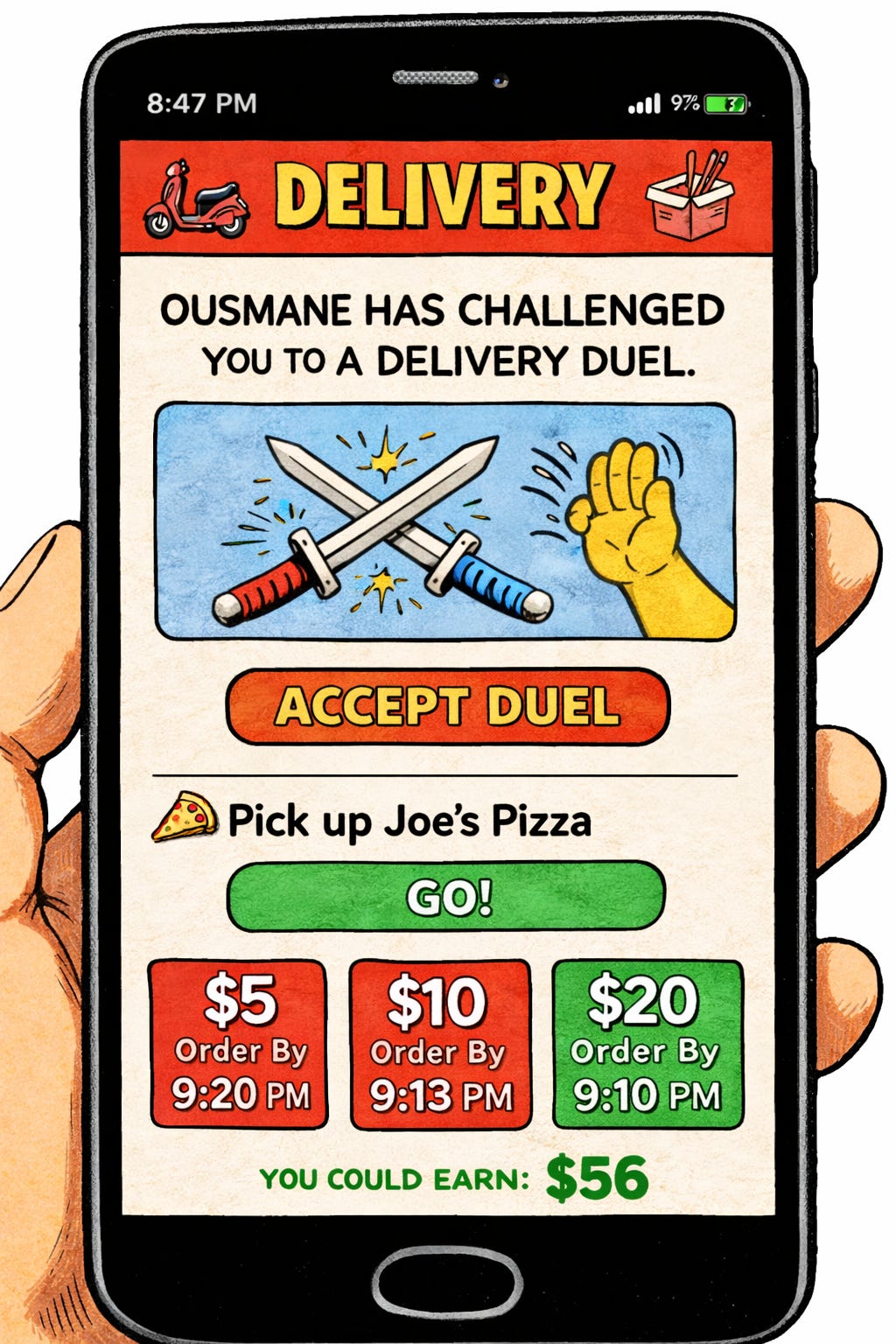
He looked at his phone. His nemesis, Ousmane, had challenged him to a Delivery Duel. Even though he had already completed five deliveries that night, he wanted to show Ousmane who was boss. While they had never met in person, their online Delivery enmity had lasted a couple of years. He took on the Duel, which resulted in a little animation of dueling swords. Mamadou high-fived Ousmane through the app to troll him, then sped to Joe’s Pizza. He hated winter pizza deliveries; the pie almost always arrived cold, and the boxes themselves were unwieldy, but that is where the luck of the draw led him. Delivery drivers couldn't see where the orders were from or what they were before they said yes.
When he got to Joe’s Pizza, the pizzas were waiting for him. The boxes were steaming in the cold, like subway grates. Mamadou thought about this paradox: the colder it got, the more people wanted to stay in and order food, which meant delivery drivers had more business but also more frostbite. He strapped the pizzas into his polar-lined basket and high-tailed it.
“Whack!” Mamadou flew through the air and into a snowpile. His bike cracked in half and split apart, darting in opposite directions. The pizzas fell out of their boxes. Someone or something had hit him.
He would be late for his order and lose the Delivery Duel bet.
There were several New Yorkers, wrapped in their ubiquitous black puffers, who stopped in their tracks and asked him if he was okay. A bodega worker came out with a wireless landline, talking to a 911 operator: “He’s alright, he looks conscious.” The bike was cracked in half, its handpicked holographic mudflaps and bumper stickers stripped of their grandeur. The other rider long gone.
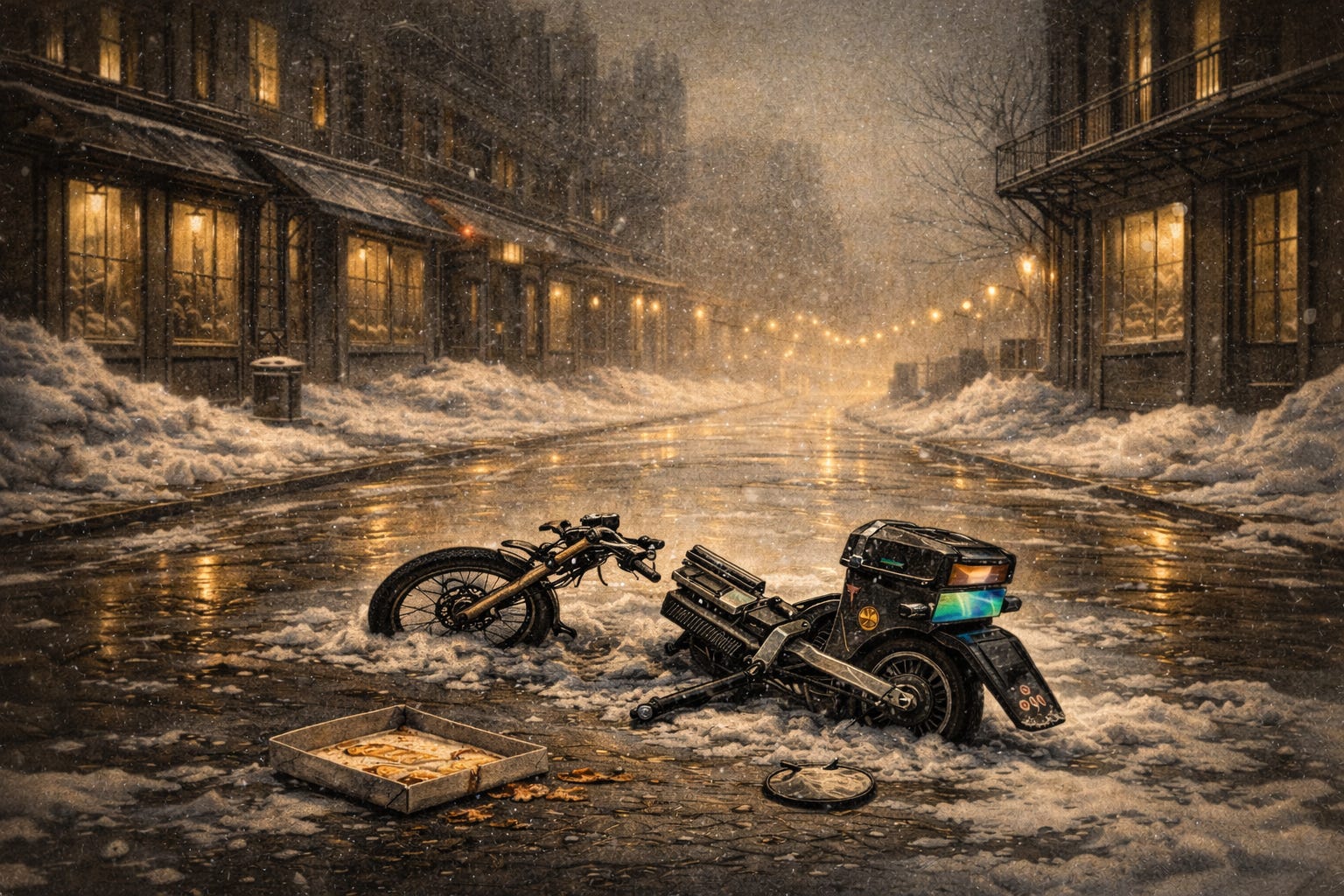
“Your bike’s destroyed, buddy, let me call you a cab.” It took Mamadou five minutes to recover his bearings. He was on the ground, eye to eye with his pizzas, refrozen in the snow. There were scratches on his hands from skidding, but other than that, he was fine. The bike, which had cost him $1600, was totaled. He still owed $400 in installments.
His Uber showed up, a Tesla, and he struggled to wipe himself off and get in. The bodega owner said he would hold on to his bike until he could come back and get it. He also said he would pay for the ride back to Harlem.
Back at home, on the couch in his tiny apartment, where he slept in the living room, Mamadou thought about getting his bike back, and how he would go to work tomorrow, his family back home expected a weekly remittance. He decided he would contact the Delivery app support. He clicked through to the driver console.
Support: Here are your recent orders. Please select the one you need help with.
Mamadou selected “Joe’s Pizza.”
Support: Thank you for confirming your order. For this order, you’re not eligible for payment or insurance coverage because the order was never delivered.
Mamadou: But my bike was destroyed before I could get it there.
Support: I cannot do anything about that. You are not eligible for coverage per Delivery’s TOS.
Mamadou: But I physically could not deliver the pizza. I had an accident.
Support: That is unfortunate. My apologies.
Mamadou: So I’m going to get payment?
Support: You are not eligible for coverage per Delivery’s TOS.
“You are a POS.” Mamadou thought and slammed his phone down on his flimsy coffee table. The AI bot vernacular was bone-chilling, colder than the ice on the sidewalk. This was the future, bots and humans, and then inevitably bots and bots, talking past each other, playing different language-games.
Somewhere, someone in Soho was not eating their Joe’s Pizza.
Mamadou sat on his couch for a while. After what seemed like hours, he picked his phone back up and opened up the Delivery app. For the first time since he started doing deliveries, he placed an order for himself, a ham and provolone sub from Jersey Mikes. He usually made food for himself, Yassa Poulet, and other homespun Senegalese dishes if he had time, or ramen if he had neither time nor money.
He pressed the ‘Order” button, and it connected him immediately with a driver. “Your order is being delivered by Ousmane.” Mamadou was feeling lucky; after all, his night couldn’t get much worse. He placed a bet.
wow you nailed the mood of NYC and the tech climate today